

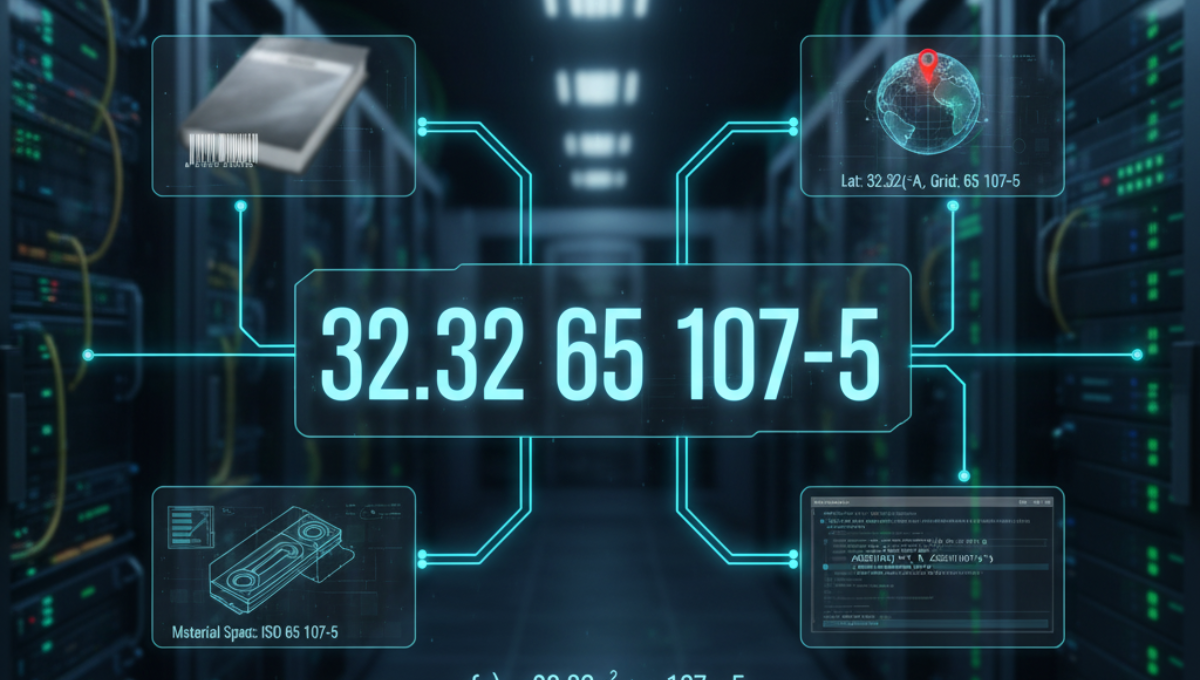
Numbers, sequences, and coded identifiers often carry special significance in technical systems, engineering standards, or classification methods. One such code that has sparked curiosity is “32.32 65 107-5”. At first glance, it may look like a random sequence of digits, but structured numeric formats like this are frequently used in scientific research, engineering documentation, product identification, or even digital culture.
In this guide, we’ll break down what “32.32 65 107-5” could represent, explore possible contexts, and analyze its uses in technology, industry, and digital references.
Understanding Numeric Sequences like 32.32 65 107-5
Before diving into interpretations, let’s first understand why structured numbers like this are important:
-
Standardization: Numeric codes are widely used in engineering, medicine, mathematics, and libraries to uniquely identify items.
-
Efficiency: Codes take less space than long descriptive names.
-
Classification: They group related items together under organized formats.
-
Data Encoding: Numbers often represent ASCII characters, system IDs, or GPS coordinates.
Given its structured format—a decimal, followed by a two-digit, three-digit, and hyphenated suffix—32.32 65 107-5 could belong to one of several categories.
Possible Interpretations of 32.32 65 107-5
1. ISBN or Cataloging System
-
The sequence resembles an ISBN-like identifier used for books or academic papers.
-
“107-5” could be a check digit at the end, ensuring the code’s validity.
2. Engineering / Standard Code
-
In ISO, DIN, or ASTM standards, numeric codes define materials, parts, or specifications.
-
Example: “65 107-5” may represent a material grade or component size, while “32.32” refers to its specification version.
3. Geographical or Coordinate Reference
-
“32.32” might be a latitude, while “65 107-5” resembles a grid or map reference.
-
Geospatial systems often use such combinations for precision mapping.
4. Computer or Digital Encoding
-
ASCII interpretation:
65 = A,107 = k. -
Together, this may encode a short text fragment like “Ak”, while the “32.32” could signify a floating-point data input.
5. Mathematical Expression
-
32.32 could represent a decimal value.
-
65 and 107 could be integers in a formula or sequence.
-
The “-5” may indicate subtraction, power, or an indexing notation.
Why Codes Like 32.32 65 107-5 Matter
Even if the exact context varies, codes of this format are highly valuable in:
-
Academic Research – Used for cataloging research papers and datasets.
-
Library & Archives – Book numbering, ISBN, or Dewey Decimal Classification.
-
Engineering & Manufacturing – Material grades, part IDs, and design standards.
-
Software Systems – Database indexing and object references.
-
Mapping & Navigation – Geocoding for global positioning.
Challenges with Codes like 32.32 65 107-5
-
Ambiguity: Without context, interpreting the sequence is challenging.
-
Multiple Uses: The same numeric structure may appear in publishing, engineering, and IT simultaneously.
-
Error Sensitivity: A misplaced digit can completely change its meaning (like ISBNs or coordinates).
How to Work with 32.32 65 107-5
If you encounter this sequence in a practical scenario, here’s how to approach it:
-
Identify the Source – Check if it comes from a database, engineering document, or catalog.
-
Look for Standards – Cross-reference with ISBN, ISO, or system-specific lists.
-
Check Encoding Systems – Convert numbers to ASCII or Unicode values for hidden meanings.
-
Consult Documentation – Many codes are explained in accompanying technical manuals.
-
Use Context Clues – Was it found in a library, a technical drawing, or a software log? That narrows interpretation.
Preventing Confusion with Numeric Codes
To avoid errors when working with structured numbers like 32.32 65 107-5, keep these practices in mind:
-
Always copy-paste carefully instead of typing manually.
-
Verify check digits (if part of ISBN or standard codes).
-
Maintain proper documentation when using proprietary codes in business or academic work.
-
Use consistent formats (hyphens, spaces, decimals) across datasets.
Conclusion
The sequence “32.32 65 107-5” may appear cryptic at first glance, but like many structured numeric identifiers, it likely belongs to a system of classification, standardization, or encoding. Whether it’s a part number, catalog entry, geographic reference, or even a digital encoding, such codes play an essential role in ensuring precision and order in our increasingly data-driven world.
Understanding and interpreting codes like this requires context, but with the right approach—checking standards, system documentation, and encoding methods—you can uncover their true meaning and apply them effectively.
