

Introduction
In today’s hyper-competitive market, customer expectations are evolving at a rapid pace. Businesses can no longer rely solely on product innovation or price competitiveness to thrive. Instead, organizations are shifting toward customer centricity—a business philosophy that places the customer at the heart of every decision, strategy, and process.
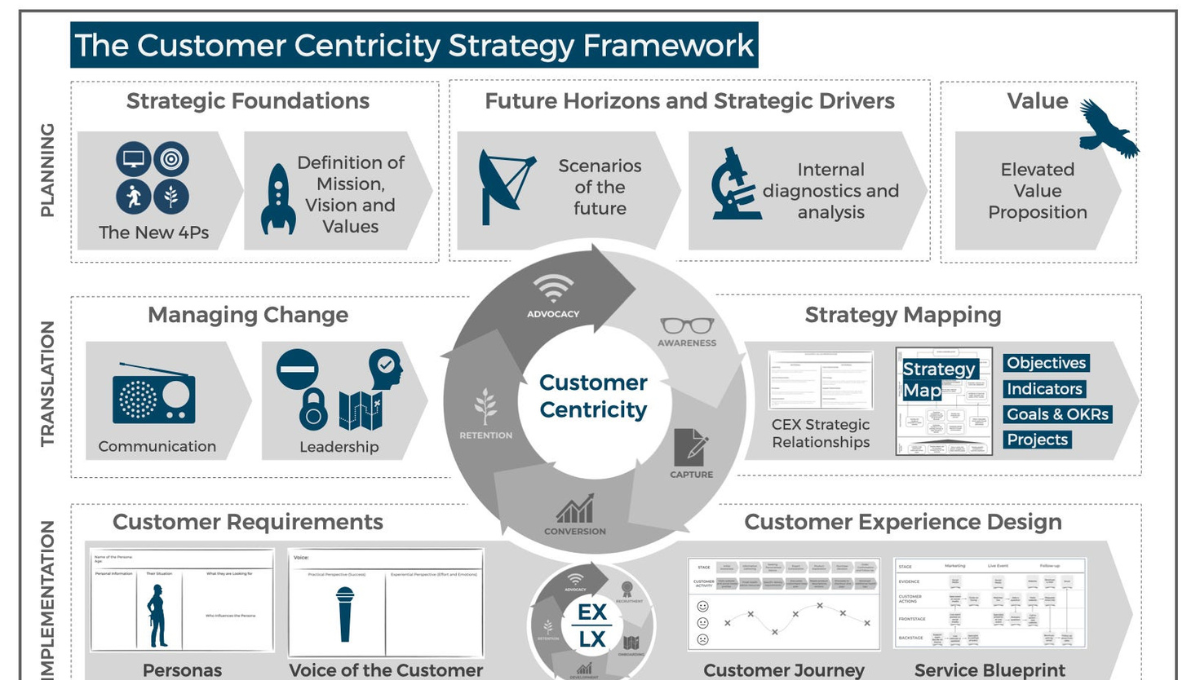
Customer centricity models provide structured frameworks that organizations can use to align operations, culture, and strategy around the customer experience. This article explores these models in depth, including their principles, different frameworks, real-world applications, and their broader impact on business growth.
What is Customer Centricity?
Customer centricity is an organizational mindset that prioritizes the needs, preferences, and behaviors of customers. Rather than simply offering products or services, a customer-centric business creates personalized, consistent, and meaningful experiences across all touchpoints.
The goal is not just to satisfy customers but to build long-term loyalty, trust, and advocacy. Research shows that companies with strong customer-centric practices are more likely to retain customers, increase revenue, and sustain growth.
Why Customer Centricity Matters
-
Improved Customer Loyalty – Happy customers are more likely to return and recommend a brand.
-
Revenue Growth – Loyal customers spend more over time compared to new ones.
-
Differentiation – Customer experience becomes a powerful differentiator in markets where products are similar.
-
Reduced Churn – Anticipating customer needs lowers dissatisfaction and attrition.
-
Stronger Brand Reputation – Customer-focused brands attract positive word-of-mouth and social proof.
Key Principles of Customer Centricity
-
Empathy: Understanding the customer’s journey and pain points.
-
Personalization: Delivering tailored experiences instead of one-size-fits-all solutions.
-
Feedback Integration: Using customer insights to refine products and services.
-
Omnichannel Consistency: Providing seamless experiences across all platforms and channels.
-
Value Co-Creation: Involving customers in shaping products and services.
Customer Centricity Models and Frameworks
There are several models businesses adopt to embed customer centricity into their strategy. Below are the most widely recognized:
1. The Customer Experience (CX) Model
This model focuses on optimizing every touchpoint in the customer journey, from awareness to post-purchase. Businesses map out these journeys to identify opportunities to enhance the overall experience.
Key Components:
-
Touchpoint mapping
-
Emotional drivers
-
Consistency across channels
Business Impact:
Brands like Apple and Disney thrive on this model by creating memorable experiences that encourage repeat engagement.
2. The Net Promoter Score (NPS) Model
This model uses customer feedback and advocacy as a measure of loyalty. By categorizing customers as promoters, passives, or detractors, companies can determine how likely they are to recommend a brand.
Key Components:
-
Survey-based feedback
-
Focus on promoters for growth
-
Addressing detractors’ pain points
Business Impact:
Organizations such as Amazon use NPS insights to continuously enhance service quality.
3. The Customer Lifetime Value (CLV) Model
CLV places emphasis on the long-term financial value of customers rather than short-term sales. Businesses identify high-value customers and prioritize resources to retain and grow these relationships.
Key Components:
-
Data analytics and segmentation
-
Predictive modeling
-
Retention and upselling strategies
Business Impact:
Subscription-based services like Netflix rely heavily on CLV for personalized content and retention strategies.
4. The Outside-In Model
Unlike traditional “inside-out” business thinking (focused on internal goals), this model shifts perspective to see the world through the customer’s eyes. It emphasizes empathy and customer-driven innovation.
Key Components:
-
Customer empathy mapping
-
Voice of the customer (VoC) programs
-
Continuous adaptation
Business Impact:
Companies such as Starbucks apply this model to evolve their offerings based on customer needs and lifestyles.
5. The Balanced Scorecard (Customer-Focused Edition)
Originally designed for overall business performance, the balanced scorecard has been adapted to emphasize customer satisfaction as a core metric alongside financial and operational goals.
Key Components:
-
Aligning KPIs with customer satisfaction
-
Measuring service quality
-
Linking customer metrics to financial outcomes
Business Impact:
Enterprises like Microsoft use balanced scorecards to integrate customer-centric KPIs across teams.
Strategies for Building a Customer-Centric Organization
-
Data-Driven Decision Making
Leverage analytics, AI, and big data to understand customer behavior and predict future needs. -
Employee Empowerment
Train and motivate employees to deliver outstanding service, making them ambassadors of customer centricity. -
Customer Journey Mapping
Visualize customer paths and identify critical pain points to improve experiences. -
Feedback Loops
Create robust mechanisms for collecting, analyzing, and acting on customer feedback. -
Omnichannel Integration
Ensure seamless transitions between online, offline, mobile, and social platforms.
Challenges in Implementing Customer Centricity Models
-
Data Silos: Disconnected systems prevent a unified view of the customer.
-
Cultural Resistance: Shifting from product- to customer-focused mindsets can face internal pushback.
-
Measuring ROI: Linking customer-centric efforts directly to revenue can be complex.
-
Technology Gaps: Legacy systems often cannot support advanced analytics or personalization.
The Business Impact of Customer Centricity
When implemented effectively, customer centricity models generate measurable business benefits:
-
Higher Retention Rates: Loyal customers reduce the need for constant acquisition.
-
Increased Revenue Streams: Through cross-selling, upselling, and repeat purchases.
-
Stronger Market Position: Customer-focused brands stand out in crowded industries.
-
Innovation and Agility: Insights from customers inspire new product development and services.
Case Studies of Customer Centricity in Action
-
Amazon
Known for being “Earth’s most customer-centric company,” Amazon personalizes recommendations, simplifies purchasing, and prioritizes delivery efficiency. -
Zappos
Zappos’ business model is built entirely around customer service, offering generous return policies and creating a culture of customer happiness. -
Spotify
By analyzing listening behavior, Spotify delivers personalized playlists like “Discover Weekly,” increasing user engagement and loyalty.
The Future of Customer Centricity
As technology continues to evolve, customer centricity will rely heavily on:
-
Artificial Intelligence (AI) for predictive personalization.
-
Machine Learning (ML) to automate customer service interactions.
-
Voice and Conversational Interfaces for seamless engagement.
-
Ethical Data Practices to build trust in an age of privacy concerns.
Conclusion
Customer centricity is no longer a trend—it’s a necessity for survival in the digital age. By leveraging customer centricity models such as CX, NPS, CLV, and the Outside-In model, organizations can transform their strategies, enhance experiences, and build long-term relationships that drive sustainable growth.
Businesses that prioritize empathy, personalization, and feedback-driven innovation are best positioned to thrive in a rapidly changing marketplace.
In short, a customer-centric strategy is not just about meeting needs—it’s about anticipating them, exceeding expectations, and creating a bond that transforms customers into lifelong advocates.
